Saturday, March 14, 2015

Owls - a quick snapshot

At Parker, we talk a lot about project-based learning and teaching multiple subjects through the use of thematic units.  I thought it would be fun to take you on a little behind the scenes tour of how a thematic unit is developed and executed from start to finish.

1.  Start with a topic:   Obviously we want to appeal to the developmental age and interests of our students.  Our most recent unit on owls was a perfect example.

2.  Generate interest: We brainstormed what we already knew about owls, activating some prior knowledge and generating excitement.  Kids were bursting with facts, stories, experiences, and ideas about owls during our initial brainstorming and idea gathering sessions.  I knew this was going to be a great unit......

3. Begin!  In this stage we read books, learned new information, and watched clips of owls on the internet. We began discussing owls in science as well, learning about the special characteristics of owls, and all the fun facts that capture a young child's imagination.  We listened to various owl calls, providing yet another glimpse into the life of this mysterious creature.

4.  Go cross-curriculum:  In art, the students carefully drew owls while observing life-like models of two owls that Susie provided.  This enabled the children to look carefully, observe certain features, and again, get excited about the topic.  They also began work on 3-dimensional paper mache owls, providing another outlet for their knowledge.  In music, the children sang owl songs.  We walked (or swooped) down the hall as silent as owls, "keeping an eye out for our prey."  We learned about which owls are present in our neck of the woods and why - incorporating a bit of geography.  In language arts, the children read about owls, looked at owl guides, and heard owl poetry.  In math, we counted and graphed the various types of owls the children were all studying, adding yet another way to assimilate and use our knowledge.

First grade mathematicians graphing owl types 


5.  Hands-on learning:  In science we looked at the feathers of owls through the lenses of microscopes and made observational drawings.  Using real taxidermied owls, the children noticed all the amazing features - the soft feathers, the intricate coloring, the sharp talons and beak.  We then drew our observations.  We dissected owl pellets (the remains of an owl's meal), giving us another hands-on, concrete example to connect us with our topic.


6.  Research and write! After weeks of study, discussion, and observation, the students were ready to choose an owl to research and write about.  We turned to our extensive collection of owl books and guides, along with the internet, and got to work. We even worked with our middle school buddies to find and record facts.  Once the fact gathering was complete, the children got to work writing.  Each child chose a few important facts about his/her owl to include in the book.  They made wonderfully detailed illustrations to go with their facts.  After some time revising and editing, viola - an owl book was born!


7.  Share and reflect:  Now it was time to share our knowledge.  The children sat in the "author's chair" and presented their books to their classmates and teachers.  It was a proud moment for all of the children. They shared their expertise, took questions, and were able to reflect on their learning.


The children were actually disappointed when the unit was over.  A sure sign of true engagement!

Monday, January 19, 2015

Nature Detectives

Last week the K-1 students had the opportunity to participate in a true interactive science activity - dissecting owl pellets. Over the past two weeks the children have been enthusiastically learning about owls. We've discussed various characteristics and types of owls, including where they live and what they eat.  The children learned that owls swallow their prey whole and cannot digest all of their food.  They subsequently cough up a small pellet with the contents of their last meal.  The pellet resembles a small, packed fur ball and once opened, reveals clues about what the owl last ate. The children found various small skulls, leg and hip bones, jaws, and other tiny bones from the unlucky creatures that happened to be dinner.


At first some of the children were unsure, wondering if the contents of the pellets might be "yucky."  Quickly, they all became mesmerized as they began discovering the bones and determining what animals the owl may have eaten.  Students became nature detectives, attempting to unravel the mystery of an owl's dinner.


This was a perfect illustration of the importance of "hands-on" science.  Children were doing the discovering themselves - which is always the most memorable and meaningful kind of learning.  I have no doubt they'll remember this activity for quite awhile.


Sunday, December 14, 2014

A Community of Writers

As the K-1's come together as a community of readers, we're also coming together as a community of writers.  Writing happens every day - formally during writing workshop, writing the morning message, writing notes and letters to friends and family, labeling drawings, and during shared and interactive writing.

The children are learning that writing has many purposes.  It's more than a collection of words on a page - writing is about constructing good stories and sharing important ideas.  Children may begin by drawing a picture and labeling their pictures with a few words.  Then we'll encourage children to say more about what they've drawn and add on to the picture.  Soon we'll help them say enough that they need to start a new page, next they'll start a new chapter, and next a new volume.  And, so it goes......

Even if some of the children are simply writing a few words to accompany drawings, they're learning about story structure and language, about how books go from front to back, and top to bottom.  This process of writing is helping children to become better and stronger readers.  As children work to construct and write the "morning message" for their classmates, they understand their words have importance - they're not only sharing a message with their class, they're also learning about spelling, punctuation, and relying on strategies for writing we have been practicing since September.

During our writing workshop, the children are completely immersed in work with sound-letter correspondences. As they work in their green "frog books" (our preferred name for our writing notebooks) constructing stories, children learn to stretch out words, isolate chunks of sounds, relate the sounds in one word to the sounds in another word, and search their memories, the alphabet chart, and the word wall to match sounds with letters.  Once they've encoded a chunk of sounds into print, they reread what they've written and continue supplying more of the needed letters.  The writing workshop could almost be retitled "The Phonics Workshop" except that, of course, so much else is being accomplished as well.

We know children learn language best when using it for real purposes.  We know that words are easier to read when they occur in a story than in a list.  Our approach is to let children learn words as they encounter them in texts that are funny or sad or otherwise, memorable.  I highly doubt you'll find any child who says, "Wow, that list of spelling words for my spelling test was fascinating!"  But, you will find a child who may struggle with an unknown word while reading about the adventures of Jack and Annie in the Magic Treehouse series, or while laughing along with Frog and Toad, and the next week use that very word in his or her writing.  This is exactly the type of meaningful learning we strive for in both reading and writing workshop.

We want school to say to children, "Welcome. Come in. You can feel at home here.  Bring your life and your stories and your ideas and energy - we are going to have a blast here, exploring all sorts of amazing things together.  One of the greatest things we'll explore here are letters and words."  I want letters and words to be a cause for our celebration, exploration, invention, talk, and laughter, and I want letters and words to be all about community.  We are involved in this process together, helping one another to sound out a word, or to spell a tricky word while writing. Children need opportunities to construct their own understandings of sound-letter correspondences and of spelling patterns.  What better way to do this than write about what's important to us, to share our stories, and gather together around a shared exploration of print?

Responding to a note 

Writing for fun


Writing the morning message


Writing in our "frog books"


Writing with our grandparents on Special Friends day 

Writing with our families


Here is more food for thought as we continue the debate about handwriting instruction. What really matters is giving students time to participate in real writing each day - something Parker students are fortunate enough to do.


Sunday, November 16, 2014

We are readers!

Wow.....things have really been moving right along in our little K-1 community.  I use the word community, because, happily, that's what we've become.  Those early days of figuring out the rules, getting used to transitions, and that all important work of making friends, have led to a cohesive, settled classroom of confident, happy children.  They all arrive eager to start their day, greet their friends, and get right to the work of learning and playing.

An overarching theme within our school day has been creating a community of readers.  We started slowly by introducing the concept of Reading Workshop, DEAR time, and coming together for many, many read alouds.  This work has payed off - we have a class of excited readers.  Children who read during choice time, children who read to one another, children who talk about and borrow books from the classroom, and children who listen intently and carefully during story time.

One of my goals this year is for children to know what it is to open a good book and become lost in another world.  For them to connect with books on a personal level, for them to identify with characters, and feel that an author may be speaking directly to them.  I know these goals sound lofty for 5, 6, and 7 year olds, but they are not.  Whether or not children are formally reading, they are still surrounded by quality literature and exposed to its beauty and magic everyday.  For children, reading wonderful literature with friends in the classroom has the power to help us escape the boundaries of ourselves.  We feel less alone when we understand that our pain and joy are shared.  When we read Wemberly Worried, about a mouse who is nervous about starting school, suddenly our own worries do not feel so strange or isolating.  When we read Charlotte's Web, we watch as Wilbur the pig comes to realize that "friendship is one of the most satisfying things in the world,"  and we apply that to our own experience in the classroom.

By reading we cross the boundaries of time and space, we read the words and live in the worlds of people from long ago, of people on faraway islands, of people that may have lives totally different from our own. Reading allows us to walk down city streets and stand in fields of wheat, live inside skin that is black, brown, or white, or see through ancient eyes or those of a child.

We need to read and talk about books in the social world of the classroom for these very personal reasons, as well as for intellectual reasons.  When we teach comprehension, much of what we teach is a depth of listening, understanding, and response. Part of teaching comprehension is making a place for thoughtful and active listening.  If we want children to listen to an author, won't we also want children to listen to each other, and be able to solve problems with their friends?  If we want children to empathize with characters in books, won't we also want them to hear each other's ideas and perspectives, and show empathy with their classmates?

If we want children to read with wide-awake minds, then we need to invite them to use these skills in the dailiness of the classroom.  Teaching reading, then, is just like teaching living.

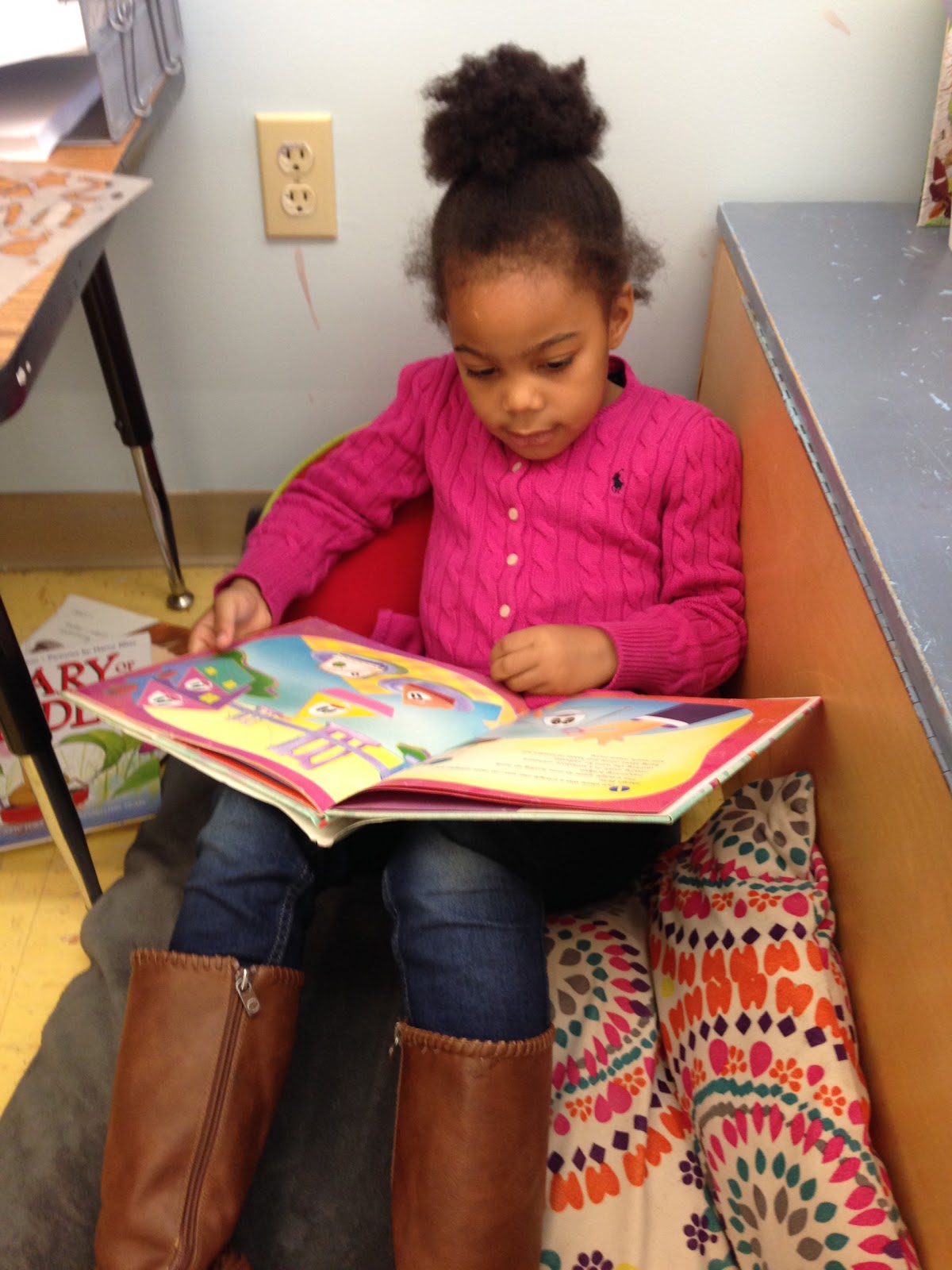
Here are some snapshots of the children enjoying D.E.A.R. (drop everything and read) time.


Next up!  Writing in the K-1 classroom.......