Sunday, May 17, 2015

Book Clubs

This past week the K-1's started their "book clubs."  We gathered together to talk as a group about what makes a good book club and what members of a book club do.  We all determined that book clubs are about coming together with a friend to celebrate and talk about reading.  Sharing ideas, thoughts, and opinions are the primary purpose of our little clubs in K-1, all while practicing our reading strategies and comprehension skills.  The goal was not going to be to read the most challenging book in our classroom library, but to choose that "just right book,"  one that your friend could read as well, one that you could retell smoothly and logically, and one you could have a worthwhile discussion about afterwards.

We brainstormed a list of potential book ideas - all titles that would appeal to a variety of readers.  For the First Graders that list included anything in the Frog and Toad series, Mr. Putter and Tabby, and of course, the beloved Magic Treehouse series.  Kindergartners are also participating - reading shorter books appropriate for their age and interests - Elephant and Piggy, as well as duplicates of classroom favorites.

Duplicates of favorite books


Children have time to read during reading workshop time, and after completing a few chapters, we gather together for a discussion.  Favorite parts, characters, plot, and storyline are all items for discussion.  As I listened to two Kindergartners chat about a book they had just finished, I overheard, "Were there any tricky parts for you?"  Then the friend answered, "Yes, I had a tough time with the word compost, but I sounded it out."  Coming together for discussions like this is an invaluable experience - to share ideas, struggles, and opinions is something these children will need to do throughout their school career and their lives.  To start this at such a young age is preparing them for the road ahead.

These book clubs are more than simply reading the book.  They're about talking, thinking, and listening to a friend.  The challenging part for many children is actually listening to one another.  Reading comprehension is all about listening at length to another person's words and ideas and stories, even if this means holding back our own ideas and words for a time. Comprehension often involves having one's own mind changed because of what another person says.  It's about coming to think differently because of what we've heard. Teaching comprehension has everything to do with teaching listening.

Sharing favorite books with a friend also teaches children that we are all unique as readers. While one club may love the Magic Treehouse Carnival at Candelight, another group may prefer Mr Putter and Tabby Feed the Fish, or Elephant and Piggy Go For a Ride.  These groups are about sharing thoughts and ideas, and coming together to think, puzzle over, and open up a story.  Our children will grow up expecting that talking about books will be fun, that friends will hang on their words when they respond to texts, and that those words will spark grand conversations.  We are teaching children that reading is a magnificent way to be together with friends and with authors who become distant friends.  They're on their way to a life in which it is possible to sit down with others to talk about ideas, to change minds, to hold fast to opinions, to listen, and to learn.


Sunday, April 26, 2015

Shaking things up.....

I'm a firm believer in the value of routine and predictability for young children.  Children thrive on knowing what is expected of them and having a sense of structure in their day. However, I also feel strongly that there is a time and place for shaking things up, and allowing children to develop skills that enable them to "go with the flow" when necessary. These past two weeks have done just that.

As soon as we returned from Spring break, we immediately got started with our Shakespeare rehearsals. For a few of the children this was new territory, and definitely caused a bit of anxiety.  At this age, anxiety in the unknown is extremely common - and normal.  Their imaginations get carried away thinking of all of the things that may go wrong, or worse, the new and challenging things that will be expected of them.   Throughout the week we came together as a group to share our worries, fears, as well as enthusiasm for the show.  Hearing classmates voice their concerns, or talk about previous experiences with Shakespeare, allowed children to feel they were not alone, and gave them the reassurance they needed to participate.


Rehearsing the balloon act


Watching intently while the other group rehearses

Having fun! 


I loved watching the kids stretch themselves during our rehearsals, and ultimately, at the amazing performance last week.  Acting asks a lot of the kids - they need to listen, take turns, cooperate, memorize lines, and most definitely leave their comfort zone. After a few days of rehearsals and getting the hang of things, I could tell even the most tentative children were showing genuine excitement.  It was hard not to get caught up in the funny stories that Sean-O had created.  By the end of last week, the kids were bursting with excitement about going on stage.   Their enthusiasm about the experience was so evident watching them on stage.  They all literally beamed with energy, emotion, and joyfulness.  Not only did they all have a great time, they also proved to themselves that this was something within their reach.  Getting up on stage, despite the worry or anxiety they felt, was actually fun!  It also provided the children with a huge sense of accomplishment.  They were so proud of themselves, and so was I.

The happy actors 


Monday, March 30, 2015

Fairy Tales

Our latest unit on fairy tales provided the children many experiences listening to and discussing these classic stories.  We've read everything from Jack and the Beanstalk, Snow White, The Snow Queen, The Three Little Pigs, Rapunzel, Little Red Riding Hood, Thumbelina to Cinderella.  These stories are at once captivating, enchanting, fascinating, and at times, slightly scary. There is magic, drama, adventure, strife, and usually a happy ending. The kids let out a sigh of relief when they hear those words, "happily ever after."

Beyond reading these captivating tales, we've also analyzed, discussed, compared and contrasted, and thought deeply about the stories.  Students are given a chance to strengthen those all important reading comprehension skills as they make sense of complicated plot twists in The Snow Queen, or compare versions of Jack and the Beanstalk and Cinderella. Questions are pondered - how is the Egyptian Cinderella similar or different from the original version of Cinderella?  The children get to stretch their thinking muscles and dig deep to compare and contrast.


Comparing and contrasting versions of Jack and the Beanstalk
Identifying story components 


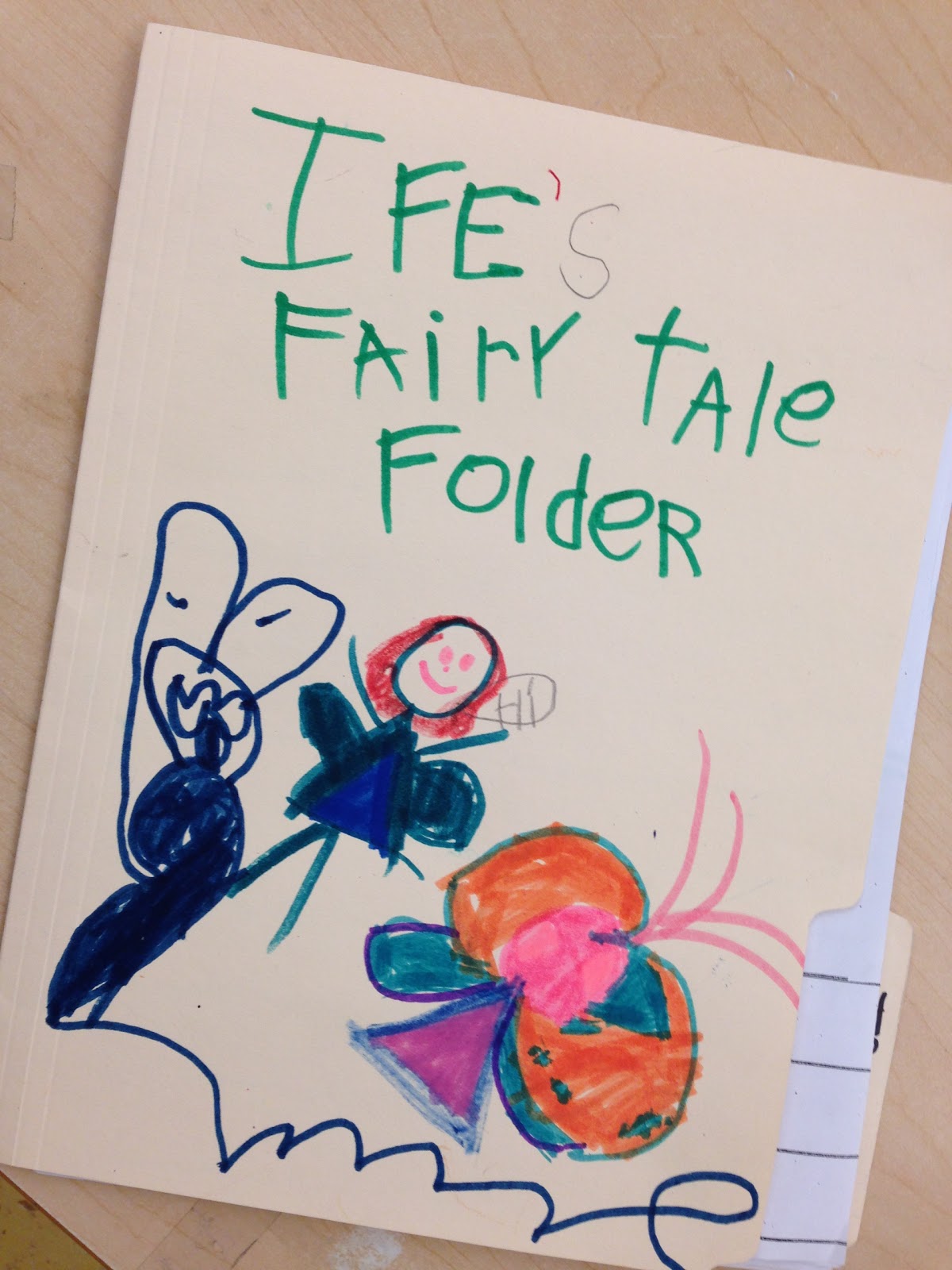
The unit culminated with writing our own fairy tales.  We all started with an outline of sorts called a "Fairy Tale Formula."  This helped students to choose a setting, create characters, and develop a plot - complete with a problem, magic, and a solution.  For some children this was extremely helpful - a way for them to organize their thoughts and remember those critical elements that make a story shine.  Other children got to work on a rough draft in their writing journals, diving right into their story. 

Title page complete! 
First draft in our writing journals

Illustrating the cover page 

Getting ready to illustrate

Outline to help organize thoughts

A first draft in our "frog" books 
One page done! 

Adding illustrations to the title page


The finished products were original and imaginative.  Some children borrowed ideas from one of the many tales we read in class or used other familiar stories as a starting point, while other children developed completely original ideas.   Getting inspiration from quality literature is a useful tool for even our youngest writers.  Some of the children may take off on their own - ideas brimming over while the pencil tries to keep up with the brain.  Others may need gentle coaxing to get their stories out.  This is all part of the writing process.   Organizing thoughts into a logical structure to make sense for readers is no easy task.  This takes planning, thinking, and hard work from our students.  The weeks we've spent sharing examples of these magical stories surely helped to prepare and inspire the students as they wrote their own fairy tales.

At the table getting ready to illustrate their stories

Finished stories awaiting assembly
This week it will be time for the children to read their stories aloud to the class.  Sitting in front of their classmates, reading their work, and taking comments and questions provides that all important, final layer of learning.  A true highlight for all.

Saturday, March 14, 2015

Owls - a quick snapshot

At Parker, we talk a lot about project-based learning and teaching multiple subjects through the use of thematic units.  I thought it would be fun to take you on a little behind the scenes tour of how a thematic unit is developed and executed from start to finish.

1.  Start with a topic:   Obviously we want to appeal to the developmental age and interests of our students.  Our most recent unit on owls was a perfect example.

2.  Generate interest: We brainstormed what we already knew about owls, activating some prior knowledge and generating excitement.  Kids were bursting with facts, stories, experiences, and ideas about owls during our initial brainstorming and idea gathering sessions.  I knew this was going to be a great unit......

3. Begin!  In this stage we read books, learned new information, and watched clips of owls on the internet. We began discussing owls in science as well, learning about the special characteristics of owls, and all the fun facts that capture a young child's imagination.  We listened to various owl calls, providing yet another glimpse into the life of this mysterious creature.

4.  Go cross-curriculum:  In art, the students carefully drew owls while observing life-like models of two owls that Susie provided.  This enabled the children to look carefully, observe certain features, and again, get excited about the topic.  They also began work on 3-dimensional paper mache owls, providing another outlet for their knowledge.  In music, the children sang owl songs.  We walked (or swooped) down the hall as silent as owls, "keeping an eye out for our prey."  We learned about which owls are present in our neck of the woods and why - incorporating a bit of geography.  In language arts, the children read about owls, looked at owl guides, and heard owl poetry.  In math, we counted and graphed the various types of owls the children were all studying, adding yet another way to assimilate and use our knowledge.

First grade mathematicians graphing owl types 


5.  Hands-on learning:  In science we looked at the feathers of owls through the lenses of microscopes and made observational drawings.  Using real taxidermied owls, the children noticed all the amazing features - the soft feathers, the intricate coloring, the sharp talons and beak.  We then drew our observations.  We dissected owl pellets (the remains of an owl's meal), giving us another hands-on, concrete example to connect us with our topic.


6.  Research and write! After weeks of study, discussion, and observation, the students were ready to choose an owl to research and write about.  We turned to our extensive collection of owl books and guides, along with the internet, and got to work. We even worked with our middle school buddies to find and record facts.  Once the fact gathering was complete, the children got to work writing.  Each child chose a few important facts about his/her owl to include in the book.  They made wonderfully detailed illustrations to go with their facts.  After some time revising and editing, viola - an owl book was born!


7.  Share and reflect:  Now it was time to share our knowledge.  The children sat in the "author's chair" and presented their books to their classmates and teachers.  It was a proud moment for all of the children. They shared their expertise, took questions, and were able to reflect on their learning.


The children were actually disappointed when the unit was over.  A sure sign of true engagement!