Sunday, January 24, 2016

Fostering empathy

Empathy is one of the most important character traits to foster in our children.  Children with a sense of empathy can see a situation through eyes other than their own, helping them to gain another perspective. These children are aware of their own feelings and are also able to relate to common feelings.  They can imagine how others may feel in a given situation and respond in a way they imagine may be comforting to that person.

Research shows that people who are empathic tend to have better social interactions, academic performance and accomplishments later on in life than others. A strong sense of empathy can help children in so many ways - making and keeping friends, making smart decisions that are right for them without hurting others or seeking approval from peers - all crucial things when navigating the social waters of childhood, and later on during the teen years.

How do we foster this all important character trait?  Is teaching our children to say sorry necessarily enough?? Often times the first thing that comes to mind when developing empathy is the ubiquitous "I'm sorry."  For children, "sorry" can be a hazy concept to understand. Saying sorry doesn’t change whatever has happened and it doesn’t necessarily ease the pain.

In the classroom, instead of expecting a simple "I'm sorry," we utilize something more tangible and meaningful - it's called "Apology of Action."  This is a way for the offending child to actually do something for the child who is sad, hurt, or upset.  Whether it is drawing a picture, helping to fix a broken block tower, sitting next to him or her at lunch, or giving the friend a hug, children are given the opportunity to fix their mistake in a concrete way.  

Actively trying to put things right can help children to feel better in a couple of ways. The first is the effect of undoing some of the harm by making things right. The second effect is by showing the child that the person who hurt him or her is sincere and genuinely wants to make things better.  When it comes to apologies, children might know it’s the right thing to do, but they might also be completely lost about why. When they see someone hurt it can be difficult to understand how a little word can strip the pain and make things right. Children live in the here and now - they benefit from seeing how their immediate actions can actually help ease the pain of others.  Seeing the smile on a friend's face after giving a hug or delivering a thoughtful picture allows children to feel the strength in being kind, empathic and emotionally responsible.

Helping a friend fix her backpack

Another practice we adopt in the classroom is the role of "The Comforter," one of the classroom jobs.  The job of the comforter is to literally help comfort children when they're feeling sad or may have gotten hurt. This is taken very seriously.  If a friend is crying in the classroom, the other children rush to find the comforter. The comforter then promptly attends to the child in need, doing whatever is necessary to make the friend feel better.

Hugs are always welcome!

It's also helpful to adopt a "feelings vocabulary."  Identifying and labeling emotions helps children organize their emotional world. Early on, children master the basics such as happy and sad, but it is helpful to expand their understanding to feelings of disappointment, frustration, excitement, nervousness, fear and so on.  Once the child understands his own feelings, he can understand other people's feelings and cross-reference them when his actions affect someone else. For instance, if the child felt sad when a toy was taken away, later they have the language to recognize that another child may feel the same way if their toy is taken away. 

Being a kid is hard work – there’s so much do and on top of that they have to get savvy with some hazy concepts. Fortunately, childhood comes with plenty of opportunities for them to explore, experiment with, and discover the best ways to navigate the world.  Developing empathy can be a lifelong process. We can't expect 5-year-olds to master this skill, nor can we expect children to feel empathy when they are in the midst of overwhelming feelings of their own. What we can expect is an open and ongoing dialogue and to hone our own abilities to model empathy in our daily lives.

Silliness with a good friend


Sunday, December 13, 2015

Growth Mindset......


The kids are all growing by leaps and bounds in the K-1s. They are stretching themselves daily, reaching above and beyond their limitations, and learning new things. Yes, there are frustrations at times, but we talk about frustration being a normal part of growth. Kids can easily get bogged down by feeling they "can't do it." My response is always the same - you can't do that YET.

This brings us to the all-important idea of the growth mindset. Children generally tend towards one of two types of mindsets – a fixed mindset or a growth mindset. Praise that focuses on intelligence promotes a fixed mindset, which is the belief that intelligence cannot be changed in any meaningful way. Children with a fixed mindset believe that they are born with certain character traits and a fixed amount of intelligence and creativity, and that nothing they do can alter that.

In contrast, praise that focuses on effort ("You’ve worked really hard on that!") promotes a growth mindset, which is the belief that intelligence can grow and be strengthened with effort. Children with a growth mindset believe that they are capable of achieving what they want if they put in the time and effort to get there.

A growth mindset will supercharge their capacity to learn and grow. We know that for certain. I'm seeing this over and over again in the classroom. We've been taking on some challenging work, and often kids get frustrated when things are not easy for them. Recently, after a challenging morning writing animal poetry (that left a few children feeling frustrated), we sat down together and I explained the growth mindset to them in a way they could understand.

"Imagine that in your brain are billions of tiny light bulbs. There is a light bulb for everything you could ever do. There’s a dancing light bulb, a math light bulb, a crossing the monkey bars light bulb, a writing light bulb, a riding-a-bike light bulb, a cooking light bulb, a reading light bulb …. You get the idea. The thing is, they only turn on when you do what they are there for, so not all of your light bulbs will glow all the time.

If you never ride a bike, for example, the riding-a-bike light bulb won’t glow at all. The first time you ride a bike, that light bulb will glow just a little bit. The more you ride your bike, the brighter the riding-a-bike light bulb will glow. It might take a lot of practice before your riding-a-bike light bulb is as bright as your teeth-brushing light bulb, but when it is as bright, you’ll be just as good at riding a bike as you are at brushing your teeth.

Of course, your teeth-brushing light bulb is very bright because you brush your teeth every morning and every night! When it comes to riding bikes though, you might fall off a few times but that doesn’t mean that you can’t be great at riding bikes. It just means that you’re not good at riding them yet. You’re still charging up that light bulb."


This idea of a light bulb charging up and glowing the more it is used has resonated deeply with the children. A particular boy said to me this week, "My reading light bulb is really starting to glow. I'm getting better every day!" Another boy, out at recess this week, said, "Wow, my monkey bars light bulb is so strong! I can now cross the monkey bars!"

Every time something is hard for the kids, I use this expression. It helps them to actually visualize their brain getting stronger by the day, and they're encouraged to keep going. Intelligence is not fixed and can be flourished with time and effort. Nurturing this belief in children is one of the greatest things we, as the adults in their lives, can do to help lift them so they can reach their full potential. The effort will come from them, but it’s important that we do what we can to have them believe that the effort will be worth it.


Sharing a book with the class 
Working with clay to make a hawk!

Writing and reading the morning message at morning meeting 

Creating a diorama 

Almost done! 

Adding detail to a diorama about the snake 

Reading a Mo Willems book aloud to classmates 

Cutting to get the perfect size paper to cover the outside of the box

A self-created book! 

Proud author of a frog research guide! 


Monday, November 30, 2015

One of the favorite routines that we've established in the K-1's is our daily "gratitude circle." This happens at the end of each day as kids come in from recess and get ready to say good-bye to one another. We sit in a circle and take turns sharing what we are thankful for. Here are some of the common responses:

"I'm thankful for....... "
  • My teachers and friends 
  • Parker school 
  • Recess 
  • My family 
  • My pets 
  • Holidays 
  • My birthday 
  • Books 
  • Being at school 
  • Playing sports

Fundamentally, gratitude is about being aware of who or what makes positive aspects of our lives possible, and acknowledging that.  Looking at this list and hearing all of the meaningful things the children are thankful for each day, makes me realize that they are beginning to understand this concept.  

Gratitude also grants perspective - in children and adults. When children recognize that the things they own and the opportunities they have come from someone other than themselves, it helps them develop a healthy understanding of how interdependent we all are - and they may be more inclined to treat others with genuine respect.

Teaching our kids to say "thank you" is important, but truly instilling a sense of gratitude in them is another matter entirely. Gratitude goes beyond good manners - it's a mindset and a lifestyle - one that can help us all live happier, more satisfied lives.


Our class gratitude tree 

I'm thankful for winter, frogs, and friends.  


Thursday, November 12, 2015

Learning from our peers

Lately, we've been doing a lot of learning from one another in the K-1's.  A few weeks ago, we welcomed George (Emmett's older brother in the 2-3's) into the classroom to teach us about the solar system.  He sat in front of the students and talked about his passion - space.  The K-1's sat rapt with attention.  Here was a peer, not much older than them, teaching about something that was meaningful to him.  A few days later, he followed up with another "lesson" and take-home activity for the kids.  This turned out to be a memorable learning experience both for George and the K-1 students.

Last week, the first graders presented the geometry books they made during math to the kindergartners. One by one, they each got up in front of the class and taught their classmates something they had learned. Their faces beamed with pride as they read their books and answered questions.  Then came the kindergartners turn - they had the chance to share their counting books with the first graders.  The first grade children showed genuine interest as they looked at each book.  This time it was the kindergartners beaming with pride.

Reading  geometry books to the class


We also recently gathered together as a community to share ideas about kindness, friendship, and solving problems.  The K-1's and the PreK 4 children got together for a "Peace Summit" to share ideas and learn from one another.  It was a productive community building activity.  The K-1's had the chance to be experts on a topic very close to their hearts.

As a teacher, I am always looking for ways to create opportunities for my students to showcase their abilities as well as demonstrate their knowledge. Designing projects and activities that develop higher-level thinking around a chosen topic is just one way to achieve this.  Having the students create these projects themselves and teach their peers is a much more fulfilling way to reach this goal.

Beyond the mastery of the material, these types of activities can instill confidence and a level of engagement that comes with pursuing a genuine interest.  While it’s unlikely that you have ever heard a person say, “that worksheet changed my life,” most people have an assignment from their childhood that they remember with pride because it was meaningful to them. More often than not, that memorable assignment was one that allowed them to express themselves and follow their passions - maybe space, math, or even kindness.

Wednesday, October 21, 2015

We have noticed many new friendships blooming in the crisp, autumn breeze.  Many of our morning meetings have been devoted to discussing how to handle the new and often challenging dynamics of friendship. Helping children move between friends on a weekly and daily basis is a lesson in flexibility for all of us. Young children can have a very difficult time recognizing social cues sent by their peers.

The most common complaints we hear are that “Mary” either won’t play with me or isn’t my friend anymore. There are a couple of directions we could take with these statements. The first is to call over the other student and directly handle the issue, attempting to solve the dilemma for all involved. The second, and more commonly used within the Responsive Classroom approach, is to meet with the affected parties and oversee a discussion in which they solve their own problems.

We encourage the children to tell each other what they are thinking and feeling. Young children (and even adults) often forget to take the other person’s perspective into consideration when weighing an issue. The emotionally injured child frequently finds that the offending party simply “went off to play somewhere else,” not even realizing that someone was left behind. At other times, we discover that the child didn’t truly ask “Sally” if she wanted to play. Instead, the child stood near “Sally” and was disappointed when “Sally” wandered off. Often children perceive there is a huge social injustice going on when in fact the offending party didn't even realize they were in the midst of game!

Perspective taking is not something we expect our four, five and six year-old students to master. In fact, it is a skill humans continue to work on throughout life. We can help our students to use language to express their own perspective. Vocalization both cements their personal understanding of a situation and allows others to consider a differing point of view. Being able to talk about a problem with a friend is a skill that will be necessary over a lifetime. It's our goal to give children the tools needed to navigate these tricky social waters.


Wednesday, October 14, 2015

Dyken Pond

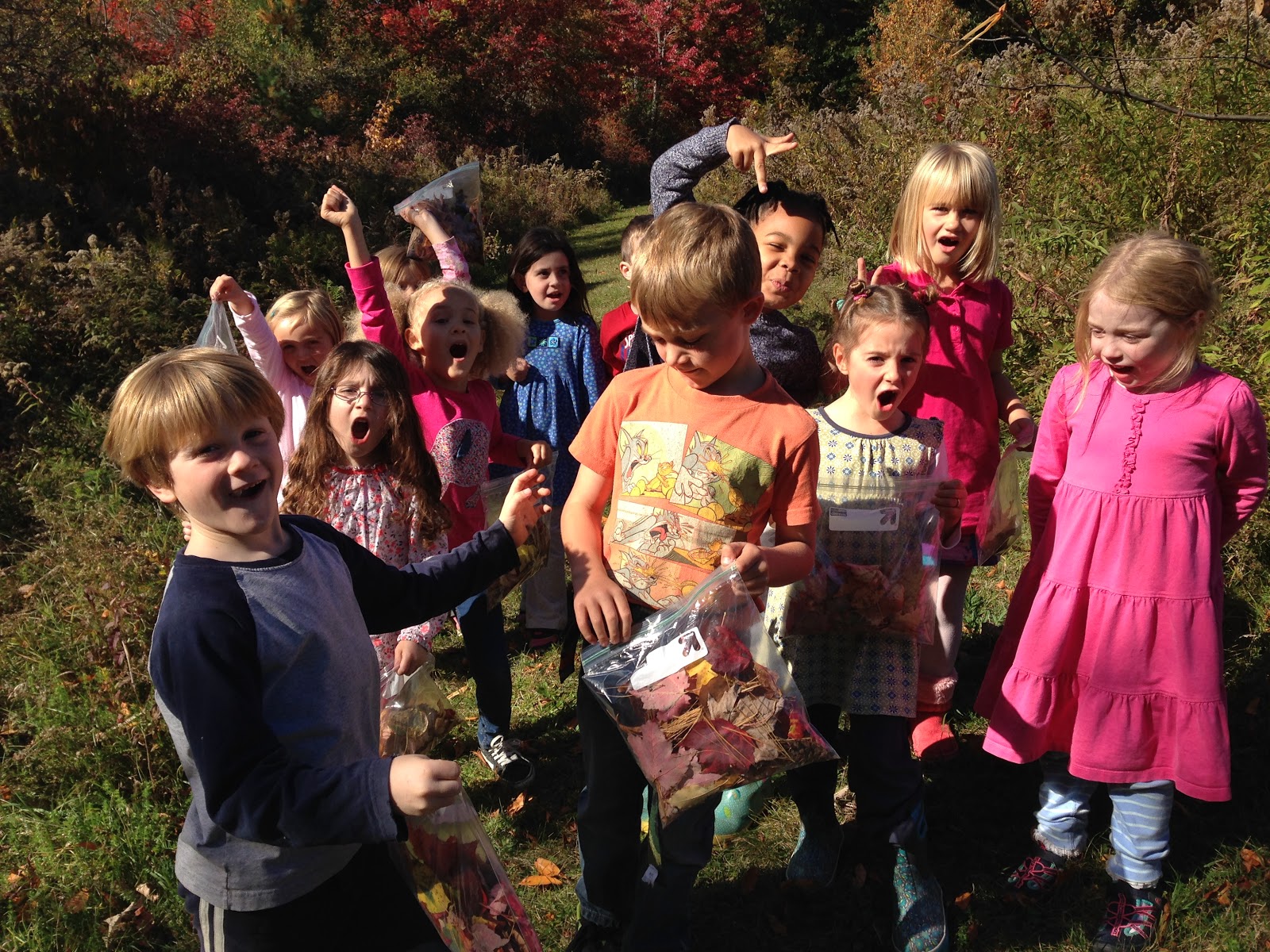
We had a spectacular day at Dyken Pond last week.  After what seemed like a rather long bus ride over some very windy country roads, we arrived to a beautiful Fall day at the pond. We were greeted by two excellent educators, Ian and Casey, who gave us a guided tour of the property, pointing out signs of animal life along the way.  We stopped by the lake to learn about differences between lakes and ponds, and about the animals who live there.

A stunning view of the lake

View from the rocks 


Look what I see! 


We paused along the way to notice a dusky salamander and the telltale signs of beaver activity.  Ian and Casey talked about the animals that live near the lake and gave us the opportunity to see and touch different animal furs (fox, beaver, and bobcat).  The children also got to see the large shell of a snapping turtle and the skull of a beaver - both items that generated lots of ooohs and aaahhhs from the group.  

We ended the hike by hearing various bird calls and looking out for these specific birds on our way back.   After a picnic lunch with friends, we gathered together for habitat relay races and a rousing game of "Bat and Moth" where kids took on the role of either a bat or a moth - exploring the idea of echolocation.    We ended the trip with a careful observation of the pond and last look around at the gorgeous fall foliage.  The children returned to school tired and happy, asking when our next field trip will be.  ;)  

A salamander

Checking out the pond
Peak Fall foliage!  

Sunday, October 4, 2015

Taking Risks


The first few weeks of school are filled with risks.  All of us, from the K-1 student to the most experienced teacher, feel this. Our children have to navigate a new set of routines, manage new personality dynamics, make friends, keep friends, decipher the emotional tone of their new class, and figure out where they fit within this new community. Taking acceptable risks when steering through all of this can be daunting. Grown-ups can put it into words, “What if I fail?” Children usually aren’t able to put it so succinctly.

In the classroom and beyond, a child chooses whether or not these risks are worth it:

  • Waiting for a teacher to call on them 
  • Calling out the answers 
  • Speaking up for their own rights (i.e. I don’t like this game. I want to play something different.) 
  • Asking to go to the bathroom 
  • Saying goodbye to a parent 
  • Raising a hand during meetings 
  • Attempting to write their name or other words 
  • Drawing a picture 
  • Joining a group or single friend in play 
  • Reading aloud to a classmate 
  • Crossing the monkey bars or rings on the playground

We want our children to be comfortable taking the risks that promote growth. It is for this reason that we create an environment that welcomes mistakes, experiments, discussion, and observation. All of the children in our room are capable of great things. We want to make sure they are willing to build the attempts to get them there.